For most first-time visitors, traffic in Ho Chi Minh City is the moment Vietnam truly hits you. Before the food, before the culture, before the heat - it’s the sound of horns, the blur of motorbikes, and the realization that the street in front of you does not “pause” to let you cross.
This guide is not here to romanticize chaos or brush off real concerns. It is designed to explain how Saigon traffic actually works, how bad traffic in Vietnam really is, how to cross the street in Saigon safely, and which traffic laws in Vietnam genuinely matter for travelers - especially those who plan to walk, use Grab, or consider renting a motorbike.
How bad is traffic in Vietnam, really?
This is the question most travelers quietly Google at night: how bad is traffic in Vietnam?
The honest answer is this:
Traffic in Vietnam is dense, relentless, and mentally exhausting, but it is not as randomly violent as it appears at first glance - particularly in major city centers like Ho Chi Minh City.
What makes traffic feel “bad” is not speed. In fact, inner-city traffic often moves slowly. The stress comes from volume and proximity. Vehicles pass extremely close. Horns are constant. There is no obvious personal buffer zone. For visitors used to wide lanes and enforced pedestrian priority, this can feel overwhelming.
However, perception and risk are not the same thing.
Traffic feels worse than it often is because:
Roads are rarely empty
Lanes are flexible rather than fixed
Pedestrians are expected to negotiate movement, not wait for silence
You cannot mentally disengage while walking
In reality:
Most inner-city traffic moves at relatively low speeds
Drivers anticipate unpredictable behavior and adjust continuously
Serious accidents are more common at higher speeds or on highways than in dense pedestrian areas
For travelers, one of the biggest stress factors is time distortion. A short distance can feel long because:
Crossing streets requires full attention
Sidewalks are inconsistent
You are constantly scanning your surroundings
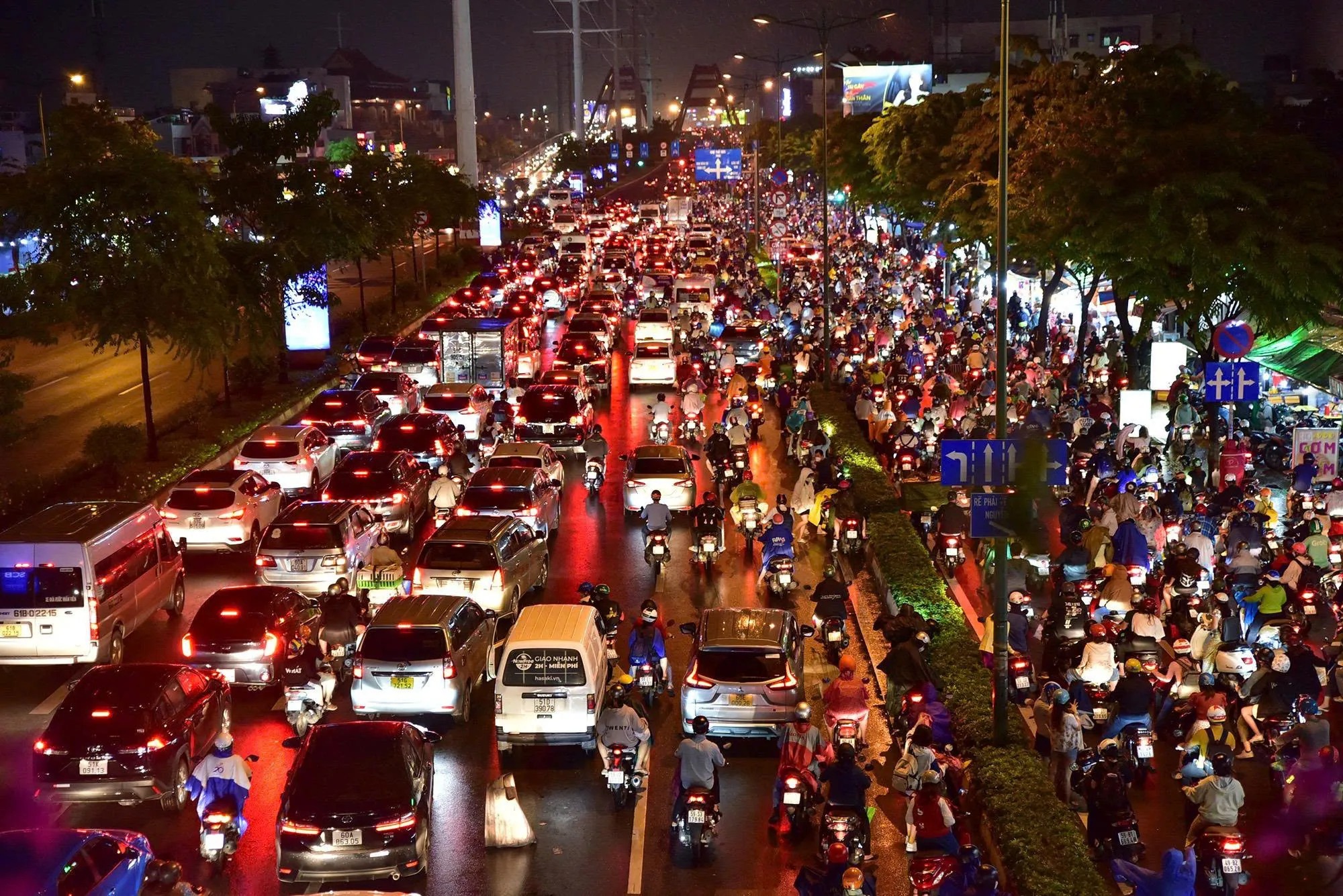
Weather makes this worse. When it rains:
Visibility drops quickly
Roads become slick
Motorbikes cluster closer together
Congestion intensifies almost immediately
So, how bad is traffic in Vietnam?
It is loud, crowded, and cognitively demanding - but it follows an internal logic. Once you understand that logic, it becomes manageable.
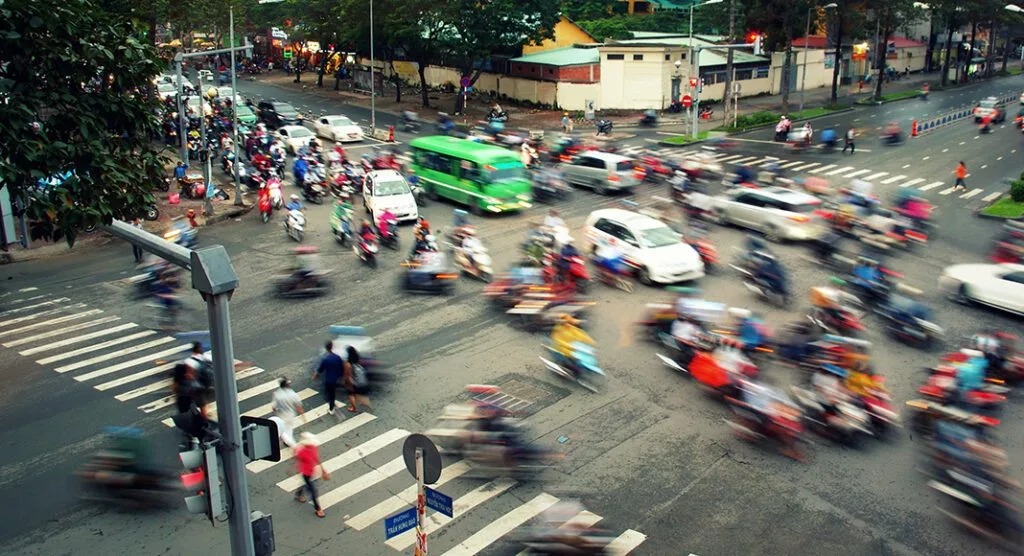
Understanding Saigon traffic: why it looks chaotic but still works
To survive Saigon traffic, you need to let go of one assumption common in Western cities: that traffic is primarily rule-based.
In Ho Chi Minh City, traffic is relationship-based and flow-based.
Motorbikes shape everything
Motorbikes dominate the streets. Their size, flexibility, and acceleration define how space is shared.
As a result:
Lanes are suggestions, not strict boundaries
Gaps open and close constantly
Vehicles negotiate space moment by moment
Drivers expect movement, not stillness. They are scanning for intent, not legality.
Why horns never stop
Horns are part of the communication system. They usually mean:
“I’m approaching”
“I’m passing through”
“Be aware of me”
They are not usually aggressive. Silence, not noise, is what makes drivers uneasy.
Why stopping suddenly is risky
Sudden stops - whether by vehicles or pedestrians - break the flow. Other road users have already predicted your path. When that prediction fails, risk increases.
This is why confidence alone does not help. Predictability does.
How to cross the street in Saigon (without panicking)
Learning how to cross the street in Saigon is the single most important skill for visitors in Ho Chi Minh City.
The key to crossing the street in Vietnam is to be calm
Many guides oversimplify this with “walk slowly and don’t stop.” That advice is incomplete. Safe crossing depends on context.
The core principle
Your job is not to stop traffic. Your job is to be readable.
Drivers will move around you if they understand what you are about to do.
Understand the traffic hierarchy
Different vehicles behave very differently:
Motorbikes: adaptive, most forgiving
Cars: slower reactions, need larger gaps
Buses and trucks: least flexible, highest risk
Crossing in a motorbike-dominated street is very different from crossing a car-heavy boulevard.
Crossing by street type
Small alleys and residential streets
Light traffic
Strong eye contact
Best place to build confidence
Two-lane streets
Mostly motorbikes
Steady walking usually works
Watch for cars accelerating through gaps
Wide boulevards
Multiple lanes
Faster vehicles
Continuous right turns
On large roads, patience matters. Cross in stages when possible. Use medians if they exist.